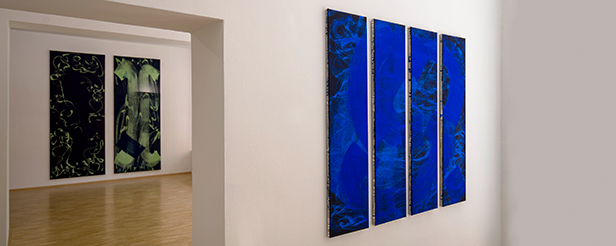
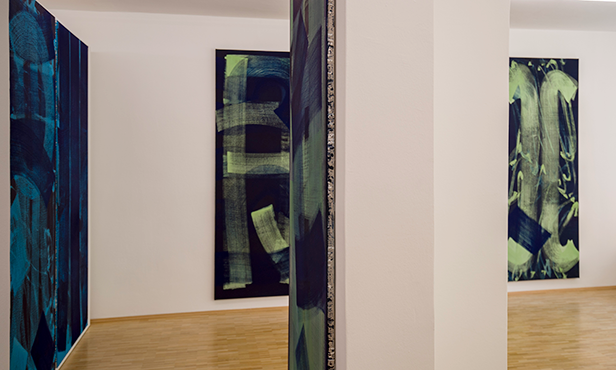
It is philosophical concepts, the processing of which, or rather, the development of which Hirtl is concerned with in her art. Hirtl's pictures are artistic approaches to fundamental concepts of the human condition or aspects of states of being, as reflected in Eastern philosophy: in her oeuvre, the concepts of time, place, self, language, and the juxtaposition of inside and outside recur regularly. Here in this selection of paintings, the artist deals with the flow of time, the course of time (also with infinity) and the notion of the self. Underlying these categories, we discern ideas likely to be influenced by phenomenology, hermeneutics, and the Japanese Kyoto School. The sign used in each case, no matter how modified it may be from the original kanji, serves as a marker; the artistic transformation of the chains of associations linked to the selected terms, however, reveals itself in the process of representation – be it in the astounding depth structure of each painting, in the sequence or juxtaposition of individual panels, or in the dissolution or fragmentation of the symbolic referent across several parts of the painting.
The dynamics of Hirtl's paintings require a kind of peripatetic contemplation: it is not a matter of a sequence of pictures (or parts of pictures), but a matter of shifting, superimposing, and condensing the contents of a painting and thus its meaning. Neither silent nor rigid observation but inner participation becomes necessary. For here no result is being presented but an event. |